






















Sport despite epicondylitis
On this page you can find out everything you need to know about epicondylitis and how you can resume your favourite sport quickly and safely despite this treacherous injury.
Epicondylitis - development and information
The Epicondylitisbetter known as Tennis elbow or Golfer's armEpicondylitis is widespread in all areas of sport, especially in weight training and sports with additional arm or hand loads (weights, sticks, rackets, etc.) and is almost a constant, uninvited companion.
This violation of the Tendon insertions of the forearm is characterised by Tensile forces which act with every movement of the arm. Overloading can lead to micro-tears, which can then become inflamed and cause severe pain.
Repetitive strain and repetitive movements then exacerbate the injury and the pain in the elbow area.
For example, due to the Strength training Yes, consciously performed, repetitive exercises - i.e. several repetitions, several sets - and the smaller overloads (sore muscles), which are also often consciously accepted, lead to a wide distribution of the tennis and golfer's arm in the Weight training and fitness area.
Especially with the Bodybuilding or Weightlifting the burdens are of course particularly great, since the high weights enormous forces act on the muscles and tendons.
The term tennis elbow or golfer's elbow depends on which muscle area and which tendon insertion is affected.
With the outer tendon, the radial epicondyleis the common name for tennis elbow, the inner tendon, the medial epicondyle is referred to as golfer's elbow or golfer's arm. Due to the widespread prevalence of the injury in both sports, these terms have become colloquially recognised as the common name for the injury. Epicondylopathy has prevailed.

Tamer Galal, Mr Universe 2004, was only able to treat his tennis elbow with the Masalo® Defeat the cuff.
Vous êtes actuelles en train de consulter le contenu d'un espace réservé de Vimeo. Pour accéder au contenu réel, cliquez sur le bouton ci-dessous. Veuillez noter que ce faisant, des données seront partagées avec des providers tiers.
Plus d'informationsTamer Galal, Mr Universe 2004, was only able to treat his tennis elbow with the Masalo® Defeat the cuff.
Tennis elbow in weight training & bodybuilding
Epicondylitis often occurs when you suffer from the Outside of the forearm is triggered by bicep curls or similar exercises. Especially when performing the exercise with a straight barbell, the angle is relatively unfavourable for the tendons, the tensile forces are particularly strong and this can favour the development of the injury.
However, tennis elbow is not always caused by sport. Even simple household, professional or PC work can trigger epicondylitis, which is often further aggravated by strength training.
The pain is often particularly severe when the body is under strain. Bicepsexercises such as Bench press, Chest press etc. - generally for exercises in which the main load is applied during the Stretching phase of the arm takes place or must be countered due to high weights.

Golfer's arm in weight training & bodybuilding
If the injury occurs at the Inside of the forearm, you have contracted what is known as golfer's elbow.
This is mainly triggered by exercises that put a lot of strain on the inner side or exert a strong pull, such as Triceps exercises with angled handles on the Train tower be, Lat pulldown, Pull-ups or also Butterfly.
Here too, however, there is no standard trigger for the injury; the development of epicondylitis can have a wide variety of causes.
The diagnosis:
If you experience pain in the elbow area or in the elbow joint, please have a Diagnosis exclusively by specialised medical personnel create. The information on our pages cannot replace this.
If you have been diagnosed with tennis elbow or golfer's elbow, we would like to introduce you to our product, which can also help you regain freedom from pain and unhindered enjoyment of sport, regardless of whether you are a bodybuilder or weightlifter, or whether you have the Strength training in the gym or at home is simply part of your well-being.
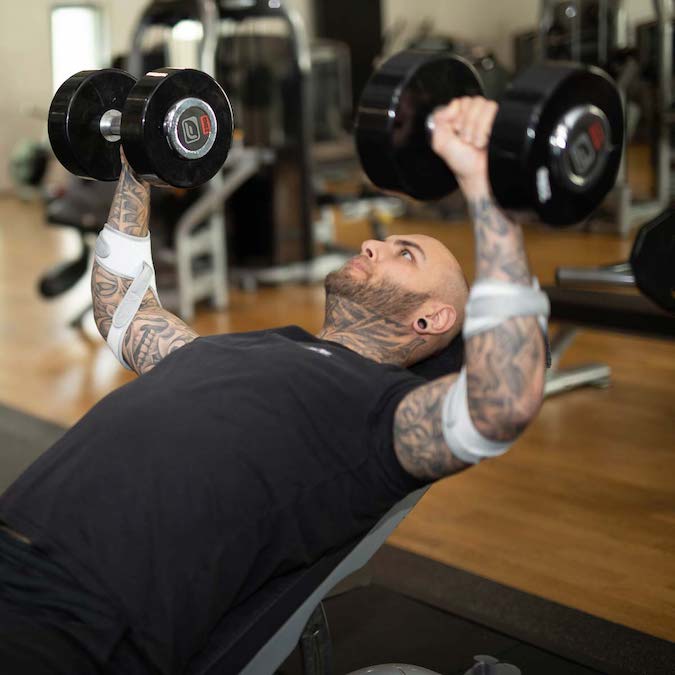
Exercising with a Masalo cuff
Whether it's tennis elbow or golfer's elbow, if the tensile forces of the forearm muscles and tendons cause the injury and make it worse with every movement, isn't it best to relieve the affected area with a countertraction?
As soon as the tensile forces of the forearm muscles are absorbed or redirected by a counter-traction system, shouldn't this clearly support the healing process and alleviate or eliminate the pain?
This is exactly what the Masalo® cuff does. The counter-traction system provides immediate and lasting relief to the affected area. The tendons are protected, pain is relieved and healing is positively supported - even though the arm continues to be used. The unique design of the Masalo® cuff means it can be worn 24 hours a day, day and night.
When playing tennis, the experience of other customers has shown that the racket position is improved. The stabilisation of the elbow leads to greater hitting power. Those affected have also benefited from the cuff in other sports such as javelin throwing, handball and volleyball.
In golf, the Masalo® cuff acts as a guide for the golf swing and can therefore improve your handicap.
Strength training can also usually be resumed quickly, without long downtimes. The cuff also ensures constant performance and drastically reduces the susceptibility of the tendons to injury despite the high loads, especially when preparing for competitions for bodybuilders and competitive athletes.
A wrist support can also help to stabilise the wrists and prevent hyperextension of the wrists.

Vous êtes actuelles en train de consulter le contenu d'un espace réservé de Vimeo. Pour accéder au contenu réel, cliquez sur le bouton ci-dessous. Veuillez noter que ce faisant, des données seront partagées avec des providers tiers.
Plus d'informations
Extreme sports with Masalo cuff
Dr Garvin Aussenegg proves with this impressive video that even extreme sports such as mountaineering etc. are possible again without any problems with the Masalo® sleeve. Without the cuffs, the pain from his golfer's arms was unbearable. After putting on the supports, however, he immediately went to the summit!
Enjoy the beauty of nature in fantastic pictures!
How does the Masalo cuff work?
The Masalo® Manschette MED works with the proven Masalo®Counter-move principlewhich is still unique in the field of epicondylitis aids.
About 70,000 customers were able to treat your injury with the help of our Masalo®This means that you can defeat your cuff and get back to your sport with renewed vigour.
The arm remains fully mobile even with the cuff.
The Comfortable underarm cuff the Masalo® The MED cuff is placed approximately in the centre of the forearm and secured with the high-quality and very durable Velcro fastener.
The Upper arm strap is then also fastened with Velcro and adjusted according to the activity and load.
Thanks to the unique and Patented design the upper arm strap stays in place with every movement. An additional element with silicone studs on the inside prevents the belt from slipping (this can also be easily removed as an option). The Tensile forces are reduced or completely stopped by the proven counter-traction principleThe affected area is relieved. The negative tensile forces are redirected to the upper arm belt.
This gives the affected tendons the chance to healalthough the arm can continue to be used and loaded.

Tips for strength training
If you use our Masalo® Cuff and have decided to keep them, we recommend the following with a view to a rapid resumption of training and a speedy recovery:
- If your cuff fits well, you can feel the countertraction/relief and you can go about your everyday life normally again, there is nothing to stop you from resuming training. However, we recommend that you do not stretch your arm completely at first and start your training with light weights and exercises.
- In the gym, for example, use less weight and do more repetitions.
- Do not work with momentum during training, but perform the repetitions extremely slowly and cleanly, taking 4-5 seconds per movement. This results in intensive training and maximum strain on the muscles, but only minimal strain on the injured tendon insertions.
- Once you have conquered your epicondylitis, continue training with the Masalo® cuff to prevent possible relapses and continue to relieve the affected area. Many of our sports customers often even use a second cuff for their training and wear it well beyond the actual injury period.
- When you are fully recovered, use the usual stretching exercises for the body and arm. This can increase the elasticity of the tendons and reduce the possibility of a recurrence of the injury.
- However, DO NOT stretch your arm if you are still in acute pain. As this represents a renewed overloading and overstimulation of the tendon insertions, it can even make the pain and the injury significantly worse under certain circumstances.
- If required, use an additional Wrist bandage For stabilising the wrists
