























Tips against epicondylitis
What helps with tennis elbow & golfer's elbow?
Understanding = getting better faster
To help you recover more quickly, it is important to at least roughly understand which movements, work and activities put particular strain on the tendons and may even aggravate the injury.
In this chapter you will read, among other things:
- Where does the pain come from?
- Negative influences
- How can I protect myself?
- Risk groups and much more.

CLICK HERE TO READ CHAPTER
There are basically two types of epicondylitis:
- Epicondylitis lateralis humeri (epicondylitis humeri radialis = tennis elbow)
- Epicondylitis ulnaris humeri (epicondylitis humeri medialis = golfer's elbow)
Flexors and extensors of the wrist
Basically, the so-called flexors and extensors of the wrist are responsible for the maximum load on the tendon insertions. The so-called extensor puts extreme strain on the outer tendon insertion (lateral, radial = tennis elbow), the flexor on the inner tendon insertion (ulnar, medial = golfer's elbow).
Tennis elbow, for example, is often diagnosed by stretching the hand towards the top of the hand and also stretching the middle finger towards the body when the arm is extended. This leads to pain on exertion.
The same applies to the golfer's arm by bending the hand extremely towards the palm.
Other negative influences - vibrations, jerky movements & co.
In addition to the aforementioned movements of the wrist and fingers, jerky movements, vibrations, hyperextension and overstretching can be responsible for extreme strain on the tendon insertions. These may prolong the duration of the disease, especially in combination, these stresses may be unfavourable.
What is the best way to protect myself?
We know that for various reasons (work-related or in certain sports) it is not always possible to avoid the movements and influences mentioned, but there are ways to minimise them.
In addition to applying the countertrade principle of our Masalo® cuff, which protects and relieves the tendon insertions, you can stabilise your wrists a little, for example.
Here we recommend the additional use of a Wrist bandage. This is intended to cushion the movements of the wrist somewhat, acting as a kind of shock absorber. The wrist should not be stiffened or immobilised in the process - the Masalo wrist support for example, is designed to help prevent overstretching or hyperextension of the wrist.
Fitness gloves with wrist support are also widely used in weight training. These gloves are available in different versions, as half or full-finger gloves, and are also very suitable as protection.
What else can I do for my tendons?
Tendons consist largely of collagen (different types) and generally have a rather poor regenerative capacity. They are so-called bradytrophic tissue (with a slow metabolism), i.e. tissue with only a few blood vessels and nerves.
As we age, our own collagen production is reduced and the tendons become less elastic.
This can be supported with the right diet and nutritional supplements.
There are very good dietary supplements, but unfortunately there are also many overpriced and useless products. For this reason, we cannot and do not wish to make a recommendation.
Please seek good advice and talk to your doctor or pharmacist about this.
Special risk groups, activities, sports
Although our Masalo® cuff is very effective, there are always customers from special risk groups or sports who sometimes have a very long recovery time.
Activities involving:
Screwdrivers, impact drills, machines that generate large vibrations / shocks, hammers, chisels, saws, fine motor movements of the fingers and wrist (dentists, opticians, podiatrists, etc.), frequent repetitions, etc.
Particularly stressful sports are
- Table tennis (off the cuff)
- Mountain biking (vibrations)
- Climbing
- Weight training & body building
- Golf
- Tennis
Stretching exercises
Every athlete knows that stretching is good and important, as is warming up. However, there are many sites on the internet that recommend stretching exercises for tennis elbow and golfer's elbow and provide instructions. Some of them claim that tennis elbow/golfer's elbow is just a cramp.
In this chapter you will read, among other things:
- Does stretching make sense?
- How do I stretch correctly?

CLICK HERE TO READ CHAPTER
We do not want to put these exercises, which obviously help some people, in a bad light or judge them negatively. However, we have had numerous customer contacts where precisely these stretching exercises have had drastic consequences. For this reason, we would strongly advise you to exercise caution.
The stretching exercises are performed by stretching the arm and then flexing and extending the hand against resistance. Strong forces are therefore exerted on the injured tendons (see also the explanations above under "Flexors and extensors of the wrist")
There is also the so-called "hanging on the pole" - where you hang on a pole (usually attached to the door frame), which also "pulls" strongly on the tendons.
Our advice on stretching exercises, hanging from the bar, etc:
We cannot agree with the recommendation on some sites to "stretch against the pain".
If you want to do stretching exercises etc., we advise you to do this carefully and cautiously. If you realise that the stretching exercises are having a negative effect on you, take a break. Listen to your body. If, for example, you experience discomfort in your golfer's arm after stretching in addition to your existing tennis arm pain, you should urgently consult a doctor.
Physiotherapy & massages
As an alternative to the very controversially discussed stretching exercises from the previous chapter, physiotherapy and massages can possibly make a positive contribution to the healing of epicondylitis. Inflammation and how to combat it is also covered in the following section.
In this chapter you will read, among other things:
- Is physiotherapy useful?
- Can massages help me?
- What can I do myself?
- Cervical spine
- Combating inflammation

CLICK HERE TO READ CHAPTER
As already mentioned, some people assume that tennis elbow / golfer's elbow is just a cramp. Based on numerous customer contacts and our own stories of suffering, we cannot agree with this statement.
But as is so often the case, there is even a small spark of truth in this statement.
Humans have a so-called pain memory and after a certain time your subconscious "knows" "Watch out, now it's time to grab again, the pain is coming...".
As a result, you unconsciously adopt relaxed postures, which means that you approach certain things in a "cramped" manner. In addition to an unfavourable posture (more on this under "Chiropractic treatments"), this often leads to cramps in the muscles. A cramped muscle contracts and puts much more strain on the tendons.
Many customers report that you can even feel these cramps in the forearm muscles and describe them as "small lumps", i.e. hardenings.
Professional physiotherapy is of course the first choice here, but unfortunately there are restrictions regarding cost coverage and physiotherapy is therefore not available free of charge indefinitely.
Massages with a hedgehog ball or a fascia roller are a really good alternative.
Buy a hedgehog ball, these are available for well under 10 euros in a double pack from well-known online platforms.
Massage instructions
Massage the entire forearm muscles with it (or even better, have it massaged) several times a week for about 10-15 minutes after work. Roll the hedgehog ball slowly from the wrist towards the elbow while applying pressure (so that it is still bearable, but it should be clearly noticeable).
This relieves cramps and increases blood circulation, which is beneficial for the healing process. This method is also gentle.
Anti-inflammation & care after the massage
Epicondylitis usually consists of two problems. Microtraumas (microtears) occur in the tendons and the body reacts with inflammation.
Although in many cases this inflammation disappears in the course of the healing process, it can also spread.
In any case, please speak to a doctor about the treatment options for inflammation, as there are numerous good options.
At the latest when you notice that the inflammation is spreading, possibly even towards the shoulder, you should definitely consult a doctor. There is also a bursa in the shoulder, which can become inflamed. Bursitis is very painful and the treatment of such bursitis can be lengthy. Therefore, please see a doctor you trust in good time.
If, for example, you feel pain at rest without putting any strain on your arm, it is likely that there is inflammation.
The inflammation often disappears as soon as the tendons heal. You can also support this.
Proven home remedies here are, for example, Retterspitz compresses, anti-inflammatory ointments, curd compresses, cooling, etc.
You should apply an anti-inflammatory ointment according to the instructions and several times a day.
For support and after the massage, it is very pleasant to apply, for example, a quark wrap (take cold quark from the fridge) or Retterspitz to the elbow, wash it off after the quark has warmed up and then apply an ointment of your choice to the elbow.
Chiropractic treatments
As soon as you are able to go about your daily life without any worries and are free of pain again, apart from the occasional "twinge", it may be helpful to see a chiropractor.
Due to the postures described above, the vertebrae, especially the cervical vertebrae, are often no longer optimally aligned. This is usually uncomfortable or even painful.
Chiropractors can provide good and gentle help here. Unfortunately, these therapists are often categorised as alternative practitioners in Germany, which means that you usually have to pay for their services yourself.
Nevertheless, we recommend that you treat yourself to a few sessions and have your spine straightened again
Exercise & Sport
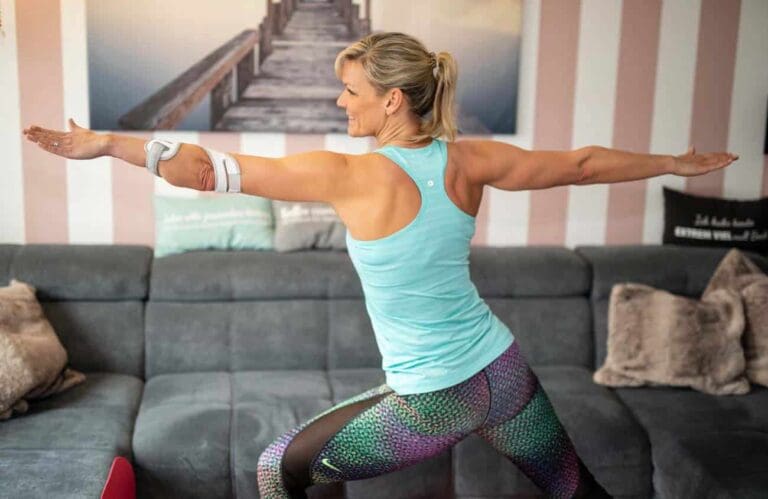
Thanks to the Masalo® cuff, you can put weight on and use your arms despite the epicondylitis. But is sport even possible and what should you bear in mind?
In this chapter you will read, among other things:
- Can I do sport despite the injury?
- What do I need to bear in mind?
CLICK HERE TO READ CHAPTER
In principle, movement is beneficial for the healing process, but there are often situations where the tennis elbow / golfer's elbow hurts so much that you cannot move.
However, as soon as you notice that the Masalo® cuff, for example, relieves the pain on exertion, move your arm as often and as normally as possible.
Exercise keeps you mobile, but you must be careful not to overdo it. If you do sport, reduce the load (use less weight for weight training) and repeat the exercises more often.
Always perform the exercises slowly and evenly and enjoy your regained quality of life.
For more information, please also read our special page "Sport despite epicondylitis"!
What do I do if the injury occurs again?
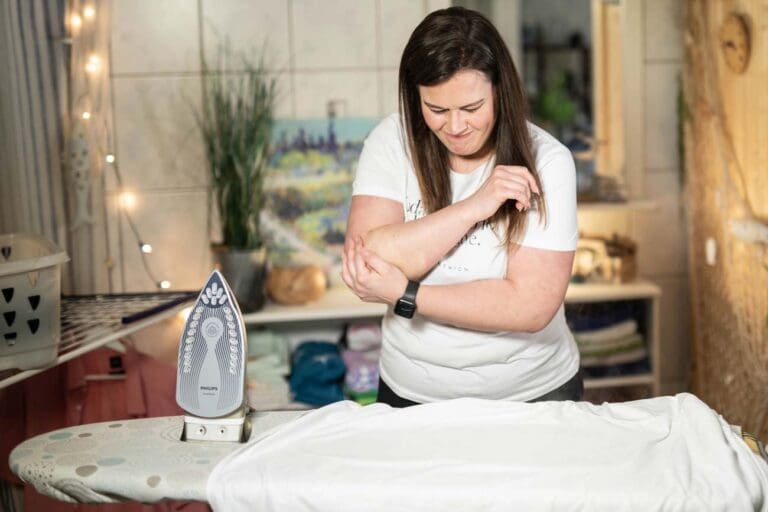
It is not a nice idea, but it is possible that the epicondylitis will return at some point despite having healed previously. Can you protect yourself against this?
In this chapter you will read, among other things:
- Why is the injury coming back?
- How can I protect myself against this?
CLICK HERE TO READ CHAPTER
Anyone who has ever had epicondylitis is generally prone to it and is not immune to it recurring.
Unfortunately, it is also not uncommon for customers to use the Masalo® Take the sleeve off too early and then feel pain again after a short time. If you use our support, wear it until you are fully recovered if possible and then wear it prophylactically during certain activities and sport.
You should never put the cuff completely out of reach and if you even begin to feel that "it's starting again", please put the bandage back on immediately. In most cases, this will prevent it from getting worse again and you will usually be through with it in a few days.
Summarising tips
We have compiled and summarised a few tips for you below so that you can use them in a compact and condensed form at a glance.
Simply click on the button below and benefit from our further tips to help you fight your epicondylitis.
